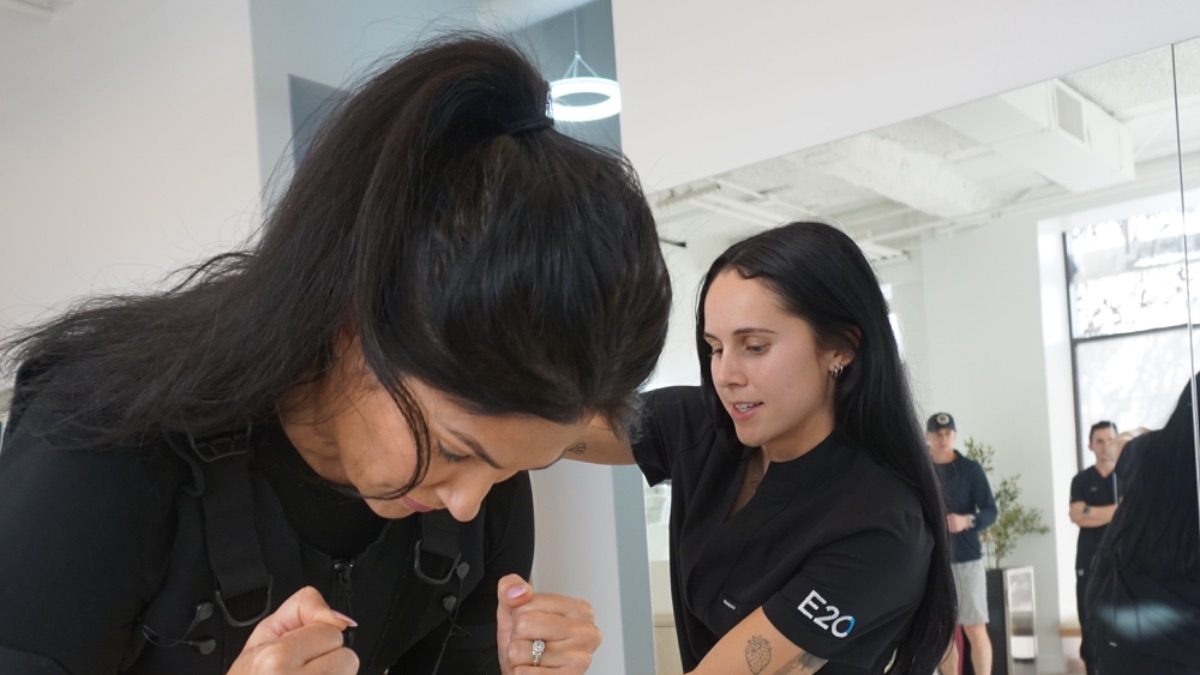
Summer schedules are often filled with travel, family commitments, and hot, humid weather, which can disrupt consistent workout routines. Fall presents the perfect opportunity to reset your fitness goals, rebuild wellness habits, and finish the year as a healthier version of yourself — both mentally and physically.
Using principles of behavioral science — like finding social support to stay accountable or boosting your self-confidence in exercise — can help you meet your goals systematically. And learning to roll with resistance or adapt your workout plan for busy seasons ensures you're in it for the long game, rather than simply checking a box for a single workout.
Our coaches at E20 Training specialize in assessing your starting (or restarting) point and creating science-backed plans to help you succeed. In this article, we share four strategies to reset your strength training and recovery routine this fall, with insights from our Head of Programming, Bridget Whitman.
Track your progress with the E20 Movement Performance Index (MPI)
"Objectively measuring progress helps our members build momentum," says Bridget, "which is central for lasting behavior change." And that's exactly what E20's MPI is designed to capture: progress. Think of it as your roadmap to improved stability, strength, alignment, mobility, and coordination.
Our innovative 20-point system tracks your progress over time, providing measurable data on how consistent EMS training enhances movement efficiency and overall performance. It's built with exercise science and biomechanics principles in mind; it assesses key movement patterns that directly contribute to longevity and functional performance — like bodyweight strength training movements and balance work.
"Every member regularly reassesses their MPI, celebrating milestones and seeing measurable proof of their efforts," adds Bridget. This ongoing feedback improves motivation, accountability, and confidence.
Create a fitness support network to stay consistent
Alongside self-monitoring progress, studies consistently show that building a support network helps you not only start an exercise program, but also maintain it for the long term. And while you will certainly feel energized after a single workout, committing to a structured routine for months — and eventually years — is linked to not only physical health and longevity, but also mental health.
A support network can include family members, friends, coaches, and even studio communities who recognize your commitment to improving health and champion you in meeting your goals. This social support can help you show up even on days when motivation is low, by creating a sense of accountability and belonging.
"At E20, our members often find that camaraderie and encouragement from coaches and peers make the journey toward their goals both more effective and more enjoyable," shares Bridget. Plus, E20's training model provides an individualized exercise prescription within a small-group setting — allowing the coaches to truly offer accountability and build lasting relationships to support each step of your journey.
Aim for a flexible, growth-oriented mindset
From a behavior-change perspective, flexibility in your workout plan helps maintain long-term adherence and prevents the "all-or-nothing" mindset that often derails fitness progress. Adopting a growth mindset helps you see challenges or obstacles as opportunities to refine your approach, rather than failures. For example, if a family commitment prevents you from exercising at your usual time, applying a flexible mindset might mean fitting in a 10-minute movement session rather than skipping exercise altogether.
"By learning to roll with resistance and adjust your training when life gets busy, you're not only strengthening your physical fitness, but also your mental resilience," says Bridget. This mental resilience makes it easier to stay consistent year-round, even when busy seasons show up. "Our members practice a growth mindset around physical fitness, which allows them to identify small wins in strength, stability, and movement quality — while understanding that results add up over time," adds Bridget.
Balance process goals with outcome goals for better results
Goal-setting is common in all facets of life, fitness and health included. And setting goals has been shown to help adults both initiate and maintain health behaviors — especially exercise and nutrition-based goals — over time. One important learning, though, is that two types of goals matter: outcome goals (what we tend to default to; the "big" goal) and process goals (the smaller steps that ladder up to achieving the outcome goal).
Behavioral science suggests that process goals are powerful, because they provide frequent micro wins, help build self-efficacy, and keep us engaged in the day-to-day habits that help us reach the outcome goal. "Combining process goals with outcome goals sets you up for both short-term motivation and sustainable success," shares Bridget. She adds, "When you stay focused on hitting the small, consistent targets — like completing your first 5 or 10 sessions — the bigger milestones tend to happen naturally."
Key takeaways
- Fall presents an opportunity to reassess your wellness routine. When you approach exercise with behavioral science in mind, you're more likely to stick with it over time.
- Tracking progress with tools like E20's MPI and goal setting keeps motivation higher and provides tangible proof of progress.
- Building a fitness support network, complete with a studio community and coaches, can help you stay consistent.
- Flexibility in your approach to exercise, and finding time-efficient ways to move like EMS training, allows you to adapt to life's demands while still making progress toward your outcome goals.
References
- Centers for Disease Control and Prevention. (2025). Strategies for social supports. National Center for Chronic Disease Prevention and Health Promotion.
- Orvidas, K. (2018). Growth beliefs predict exercise efficacy, value and frequency. Psychology of Sport and Exercise, 35, 41–47.
- Paxton, R. J., Taylor, W. C., Hudnall, G. E., & Christie, J. (2012). Goal Setting to Promote a Healthy Lifestyle. International Proceedings of Chemical, Biological & Environmental Engineering, 39, 101–105.
Reset your routine, the measurable way.
Book your E20 Movement Performance Index and see exactly where you stand — then build from there.
Book Your First Session